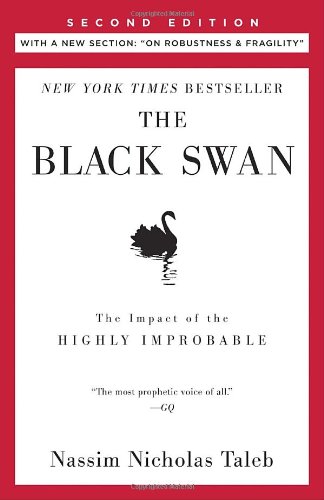
No, not the movie/ballet. The NYT bestselling nonfiction (because “philosophy” sounds too scary) book by Nassim Nicholas Taleb. I’ve heard a lot about this book, and I’ve heard it’s very good. It’s definitely challenging.
After reading Outliers, I was a little disappointed. I wanted something more in-depth and controversial. The Black Swan is definitely that. The central theme of the book is summed up in its subtitle, “The Impact of the Highly Improbable.” Broadly, Taleb thinks that humans as a whole are poorly adapted to live in an environment where a single event can change the world. These are “black swans” (a couple of black swans that Taleb, or “NNT,” as he calls himself, uses as examples are the terrorist attacks of September 11th 2001 and the “black Monday” stock market crash of October 19th 1987). Because we don’t appreciate the impact of these events, Taleb argues, not only are we driving a car while blindfolded, but we’ve deluded ourselves into thinking that we can see the road.
I like what Taleb has to say. I often think that human fallibility is massively under appreciated. He clearly thinks of himself as a philosopher and a forward thinker. I like that. I think philosophy is cool and I like to be challenged by new ideas. My issue with NNT is that he is not nearly as good a writer as he thinks he is.
Taleb is a braggart. You can’t get 5 pages without being reminded of how much clearer he sees the world than anybody else, or how well read he is, or how many successful people he knows. It’s as bad as reading a Tim Ferriss book. Oh, and that kind of finger-pointing joke is a common theme in this book. You’ll just be reading a passage and then, out of nowhere, NNT will call out the French for something trivial.
Not that he hates the French, because he seems to throw untranslated French phrases around like bowling pins at a juggler’s convention. He has a fair number of Latin phrases as well, and in case you can handle that, he endlessly meanders from tangent to tangent. In the introduction, Taleb says that this book was easy to write, that it flowed out of him. To that I say, “We can tell.” Maybe he should have used all of his fabulous wealth (or as he calls it, “f*** you money.” Why he’s afraid to write the word “fuck,” I was never able to discern) to hire an editor. It’s a shame, because throughout the book, I can see glimmers of good ideas, but there’s so much drudgery in the way. I think that this book could have been made two, maybe even three times as good if he had been willing to cut out maybe half the word count.
Thad said, the ideas are there. In fact, there was a 20 page segment about two thirds of the way through the book where I finally felt like I was reading something meaningful. This book is important. NNT organizes it into three parts. The first is about the “narrative fallacy,” our tendency to pick lucky winners and invent reasons why they were successful. This is the part of the book that reminded me of Outliers. The second portion deals with our inability to predict the future. NNT takes issue with a lot of traditional statistics, but either his unwillingness to include formulas and graphs or his inability to explain his ideas clearly leaves this section feeling rather muddy. I think there are a couple of good supplements for this section. The third section is more in depth and focuses on how to live in a world with black swans. This is the section with the most math and graphs, and it’s correspondingly the quickest to read and understand.
This is a difficult book. If I were teaching it, I would have a long list of prerequisites. I think for the average reader, Outliers will help with the section on the narrative fallacy, and The Signal and The Noise (by Nate Silver) will help with the section on prediction. Silver writes on a similar topic with much better skill (and, as a trained statistician, better understanding). I think a rudimentary understanding of statistics is important to understand the third section and NNT’s issues with the Gaussian bell curve (The Signal and the Noise provides a good overview of these issues, but you might want more to get the most out of the third section). Also, unless you enjoy feeling like an idiot, you should get comfortable puzzling out untranslated French and Latin phrases.
Let’s say you have all that. Is it worth reading this book? NNT truly is a terrible writer. He repeats himself without saying anything. He doesn’t know how to distinguish between points that will be relevant later and random tangents, so you can never get into the flow of the book. For some strange reason, he repeatedly encourages you to skip the only chapters that have any actual meat. Taleb clearly thinks of himself as continuing the great tradition of literary philosophy, but I’d say he’s still a long way from his goal.
For the first two thirds or so of The Black Swan, I was intrigued, but not impressed. If I had stopped, I would have told you not to bother. But the last third of the book is much better, and it convinced me of the depth and importance of NNT’s ideas. I didn’t get as much out of this book as I could have (part of me wants to blame his writing), so I know I’ll read it again. I know I’ll be just as angry with his writing, but the ideas in there are worth it. And that’s what it comes down to: reading this book gives you a lot to think about, and for that reason alone, I recommend it.
See the full list of books that I’ve read for this project here.
Leave a Reply