You are currently browsing the archives for the Books category


I read one book every week for all of 2013

At the end of 2012, inspired by this blog post, I decided to read one book every week for all of 2013. And I did it! You can check out the full list here, so this post is mostly going to be some wrap-up thoughts.5252
First off, reading one book every week was hard. Sometimes I didn’t like the book, sometimes I didn’t have time, and sometimes I was just lazy. That meant that I needed to read a lot of short, easy books to fill in gaps. I think I read a few too many (I would have liked to read more meaty fare), but that’s just part of the process. Overall, I read 14 filler books (labeled “Misc” in the chart below) compared to 11 fiction, 11 non fiction, and 8 literature.
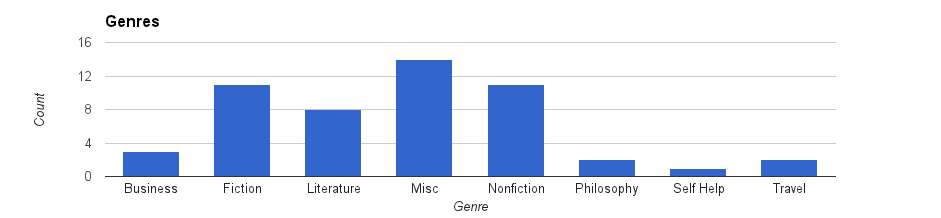
chart_1


Sorry about the numbering on the left axis, I can’t figure out how to make Google Docs do it by ones instead of fours.


The Best and Worst

In true end of year wrap-up fashion, I want to go through these genres and talk about my favorite and least favorite books in each category.
Continue reading →

Week 52: Howl

I saw the best minds of my generation destroyed by madness, starving hysterical naked,

dragging themselves through the negro streets at dawn looking  for an angry fix,

angelheaded hipsters burning for the ancient heavenly connection to the starry dynamo in the machinery of night,


I just finished Howl and Other Poems by Allen Ginsberg. To tell the truth, I don’t have much to say about this book. I don’t normally read much poetry, so it was good to step outside of my comfort zone. I’ve read parts of Howl before, and I didn’t really get it. On this read through, I still didn’t get it, but I liked it a lot more.

It’s a very famous book with a lot of history (the court case, etc) and for people living in San Francisco I think it’s an important piece of history to be familiar with.


See the full list of books that I’ve read for this project here.

Week 51: The Scottish Play

I just finished MacBeth (known in theater circles as “The Scottish Play” because it’s considered bad luck to say “MacBeth” outloud), and I have to say that the more of Shakespeare I read, the more I like him.

I don’t have a lot to say about this play that hasn’t been said more eloquently by someone much smarter than I, but I did really enjoy it. Of course, MacBeth is extensively quoted, so it was fun to read those famous lines (“out, damned spot!” and “double, double/toil and trouble” come to mind), but I also caught a quote from the BBC House of Cards that I didn’t realize was from Shakespeare.

MacBeth also really reminds me of the Game of Thrones/A Song of Ice and Fire books (Obviously, given the centuries difference in publishing dates, ASOIAF borrows from MacBeth rather than the other way around, but I still need to point this out or else people get mad at me and try to “correct” me that MacBeth came first. Duh.). Several of the characters in ASOIAF are driven by prophecy. They hear “You will be Queen” and go mad with power. George R.R. Martin also keeps his prophecies vague and makes them come true in unexpected ways, similar to the “no man of woman born” line in MacBeth.

I don’t have much more to say. It’s Shakespeare. It’s a classic. It was a fun read.


See the full list of books that I’ve read for this project here.

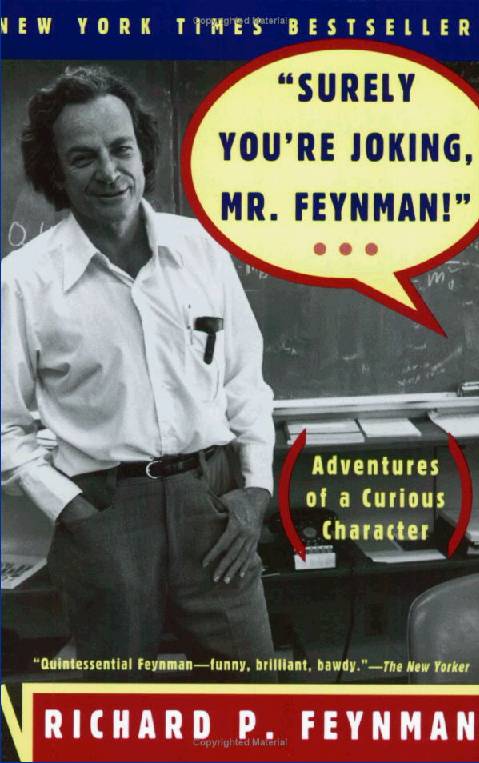
Week 50: Surely You’re Joking, Mr. Feynman!

Last week I read Surely You’re Joking, Mr. Feynman! a memoir by Richard Feynman. In case you don’t know who he is, Richard Feynman is one of the coolest people to live during the 20th century. Not only was he a Nobel-prize winning quantum physicist who helped invent the atomic bomb, he dabbled in biology, he was a professional musician (he played in an all-percussion ballet that Surely Youre Jokingcompeted in international choreography competitions, a safecracker, a professional artist (mostly sketches), and an all-around smart ass.

Dick Feynman had a great way of looking at the world: he was curious. He was always trying to figure out how things worked, and when he did, he would exploit that knowledge to mess with people just for fun. I really admire his ability to find literally any topic interesting – it’s really refreshing in a world where you see healthcare experts focusing only on healthcare because “everything else is boring,” and technology folks focusing only on technology because “that’s where the innovation is.” There are amazing things all around us and Feynman understood that it’s patently ridiculous to blind ourselves to that.

Continue reading →

Week 48: The Tao Te Ching

He who tiptoes cannot stand; he who strides cannot walk.
He who shows himself is not conspicuous;
He who considers himself right is not illustrious;
He who brags will have no merit;
He who boasts will not endure.

– XXIV

Continue reading →

Week 47: Read ‘Em and Reap

This week I read Phil Hellmuth Presents Read ‘Em and Reap: A Career FBI Agent’s Guide to Decoding Poker Tells. It was really good.

Right after finishing up the book, I loaded up Youtube and watched some pro poker. I was immediately able to spot tells in the first couple of hands. Now, I’m not saying that I could sit at the final table and win, but I’m convinced that making a concerted effort to learn how to read these tells will improve my poker game.

A book that’s been on my reading list for a while is a book by Ed Miller about “playing the player instead of the cards.” You hear about that a lot in poker, but I’ve never really moved up to that stage. Having read this book, I’m a lot more confident in my ability to predict my opponents’ moves and try to play one move ahead of them. Continue reading →

Week 46: Spies Among Us

This week I read Spies Among Us: How to Stop the Spies, Terrorists, Hackers, and Criminals You Don’t Even Know You Encounter Every Day, which incidentally wins the award for longest book title so far this year. It’s a nonfiction spy book. And yes, maybe I am on something of an espionage kick right now.

I remember reading Spies Among Us a few years ago and really liking it. It’s designed to help businesses and every day people secure themselves from crime and corporate espionage. The book is divided into three sections. In the first, author Ira Winkler draws parallels between the ways spies compromise government secrets (like troop movements), the ways industrial spies compromise corporate secrets (like an upcoming product spec), and the ways criminals compromise personal information (like your credit card information).

Continue reading →

Week 45: Call for the Dead

I read another Le Carré novel this week, Call for the Dead. It was his first novel, but still a really strong showing. I’m not going to talk about it much because it’s genre fiction. Either you like it or you don’t. But I have to say that I love this stuff.


See the full list of books that I’ve read for this project here.

Week 44: The Spy Who Came in from the Cold

I finished John le Carré’s The Spy Who Came in from the Cold about an hour ago, and I’m still kinda stunned by it. I’ve always liked spy movies and the like, but I’ve never been much for spy novels. This book changed that.

Spy is really unassuming. At first the short chapters breeze by, but as different, seemingly coincidental events unwind it all of the pieces begin to fall into place. The short chapters make for a fast pace, which suits the style of the novel so perfectly. Espionage is a game played with high stakes and very little information, and we don’t know the final score until the very last page. The short chapters also made this book very readable, and I think it’s much more approachable than another espionage classic, The Day of the Jackal.the-spy-cold

Continue reading →

Week 42: The Startup of You

I’ve been reading The Startup of You by Reid Hoffman and Ben Casnocha. It’s okay. These guys basically posit that in the fast paced world we live in today, you need to treat your career like a startup. That means being agile, weathering small shocks and sudden changes, weighing risk, and building a network. I really want to like this book, but it just isn’t that useful.

Overall, TSoY seems unfocused. I can’t tell how they decided to order the chapters or what kind of logical progression they follow. Parts of it are about agile entrepreneurship. Little Bets covers the same material but better. Parts of it are about intelligent risk assessment and taking action in a knowledge-poor environment. This has a lot of overlap with Black Swan, they even cite it in chapter 6. Continue reading →